


- In this video you will learn about Methods like Save-persist-saveOrUpdate Using a demo projectBelow is the GitHub link to download source:https://githu.
- In this Video, You will learn about save persist and saveorupdate methods in hibernateBelow is the GitHub link to download source:https://github.com/kishanja.
- So saveOrUpdate method calls save method if there is no record in database, and it calls update method if there is a record in database. Related Posts: getTransaction,beginTransaction,getIdentifier in Hibernate; CRUD operations using Hibernate+ Maven+ Oracle+ XML mapping.
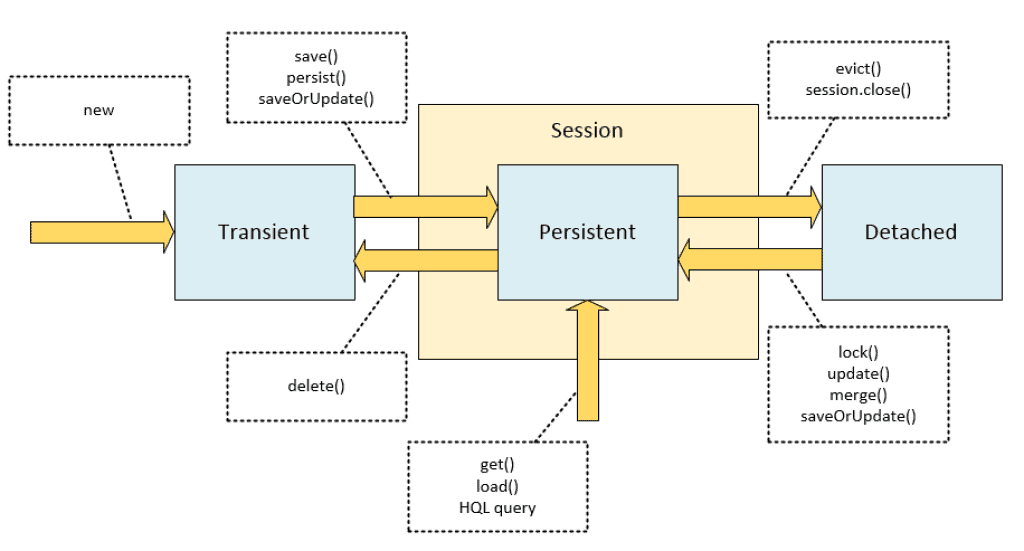
The Session interface in Hibernate provides a couple of methods to move an object from a new or transient state to a persistent state e.g. Save, saveOrUpdate, and persist are used to store an object into the database, but there are some significant differences between them. The Session.save method does an INSERT to store the object into the database and it also returns.
1. Overview
In this tutorial, we'll discuss what cascading is in JPA/Hibernate. Then we'll cover the various cascade types that are available, along with their semantics.

Further reading:
Introduction to Spring Data JPA
Mapping Entity Class Names to SQL Table Names with JPA
2. What Is Cascading?
Entity relationships often depend on the existence of another entity, for example the Person–Address relationship. Without the Person, the Address entity doesn't have any meaning of its own. When we delete the Person entity, our Address entity should also get deleted.
Cascading is the way to achieve this. When we perform some action on the target entity, the same action will be applied to the associated entity.
2.1. JPA Cascade Type
All JPA-specific cascade operations are represented by the javax.persistence.CascadeType enum containing entries:
- ALL
- PERSIST
- MERGE
- REMOVE
- REFRESH
- DETACH
2.2. Hibernate Cascade Type
Hibernate supports three additional Cascade Types along with those specified by JPA. These Hibernate-specific Cascade Types are available in org.hibernate.annotations.CascadeType:
- REPLICATE
- SAVE_UPDATE
- LOCK
3. Difference Between the Cascade Types
3.1. CascadeType.ALL
CascadeType.ALLpropagates all operations — including Hibernate-specific ones — from a parent to a child entity.
Let's see it in an example:
Note that in OneToMany associations, we've mentioned cascade type in the annotation.
Now let's see the associated entity Address:
3.2. CascadeType.PERSIST
The persist operation makes a transient instance persistent. Cascade Type PERSIST propagates the persist operation from a parent to a child entity. When we save the person entity, the address entity will also get saved.
Let's see the test case for a persist operation:
Difference Between Save And Saveorupdate In Hibernate
When we run the above test case, we'll see the following SQL:
3.3. CascadeType.MERGE
The merge operation copies the state of the given object onto the persistent object with the same identifier. CascadeType.MERGE propagates the merge operation from a parent to a child entity.
Let's test the merge operation:
When we run the test case, the merge operation generates the following SQL:
Here, we can see that the merge operation first loads both address and person entities and then updates both as a result of CascadeType.MERGE.
3.4. CascadeType.REMOVE
As the name suggests, the remove operation removes the row corresponding to the entity from the database and also from the persistent context.
CascadeType.REMOVE propagates the remove operation from parent to child entity.Similar to JPA's CascadeType.REMOVE, we have CascadeType.DELETE, which is specific to Hibernate. There is no difference between the two.
Now it's time to test CascadeType.Remove:
When we run the test case, we'll see the following SQL:
The address associated with the person also got removed as a result of CascadeType.REMOVE.
3.5. CascadeType.DETACH
The detach operation removes the entity from the persistent context. When we use CascadeType.DETACH, the child entity will also get removed from the persistent context.
Let's see it in action:
Here, we can see that after detaching person, neither person nor address exists in the persistent context.
3.6. CascadeType.LOCK
Unintuitively, CascadeType.LOCK reattaches the entity and its associated child entity with the persistent context again.
Let's see the test case to understand CascadeType.LOCK:
As we can see, when using CascadeType.LOCK, we attached the entity person and its associated address back to the persistent context.
3.7. CascadeType.REFRESH
Refresh operations reread the value of a given instance from the database. In some cases, we may change an instance after persisting in the database, but later we need to undo those changes.
In that kind of scenario, this may be useful. When we use this operation with Cascade Type REFRESH, the child entity also gets reloaded from the database whenever the parent entity is refreshed.
For better understanding, let's see a test case for CascadeType.REFRESH:
Here, we made some changes in the saved entities person and address. When we refresh the person entity, the address also gets refreshed.
Difference Between Save And Saveorupdate In Hibernate With Example
3.8. CascadeType.REPLICATE
The replicate operation is used when we have more than one data source and we want the data in sync. With CascadeType.REPLICATE, a sync operation also propagates to child entities whenever performed on the parent entity.
Difference Between Update And Saveorupdate In Hibernate Windows 7
Now let's test CascadeType.REPLICATE:
Because of CascadeType.REPLICATE, when we replicate the person entity, its associated address also gets replicated with the identifier we set.
3.9. CascadeType.SAVE_UPDATE
CascadeType.SAVE_UPDATE propagates the same operation to the associated child entity. It's useful when we use Hibernate-specific operations like save, update and saveOrUpdate.
Let's see CascadeType.SAVE_UPDATE in action:
Update Vs Saveorupdate Hibernate
Because of CascadeType.SAVE_UPDATE, when we run the above test case, we can see that the person and address both got saved.
Here's the resulting SQL:
Difference Between Update And Saveorupdate In Hibernate Windows 10
4. Conclusion
In this article, we discussed cascading and the different cascade type options available in JPA and Hibernate.
Difference Between Merge And Saveorupdate In Hibernate
The source code for the article is available on GitHub.